

This article examines the impact of the use of explosive weapons in conflict escalation in Lebanon on water infrastructure, farmers and food security between October 2023 and April 2025. Based on Insecurity Insight research and key informant interviews conducted in Nabatieh, South, Bekaa and Baalbek-Hermel governorates, it highlights the long-term indirect and reverberating effects from the use of explosive weapons on civilian populations.
Introduction
Water supply and food production systems are indispensable to civilian well-being and survival. Lebanon is often referred to as the “water tower of the Middle East,” owing to its significant water resources. In large rural areas of the country, agriculture is a significant economic activity as well, as the agri-food sector contributed up to 80 percent of the gross domestic product of the Bekaa, Nabatieh and South regions pre-conflict.1 However, since October 2023, the high intensity use of explosive weapons by Israeli armed forces during the escalation of hostilities with Hezbollah has seriously undermined the functioning of Lebanon’s water supply and food production systems.
Insecurity Insight undertook research to better understand the impact of the use of explosive weapons in conflict escalation on water infrastructure, farmers and food security in Lebanon between October 2023 and April 2025. This article highlights the findings from this research and supports existing evidence regarding the foreseeable long-term reverberating effects on civilians from the use of explosive weapons. The findings are based on key informant interviews with 78 individuals including water specialists, farmers and affected communities in Nabatieh, South, Bekaa and Baalbek-Hermel governorates in late March and April 2025, as well as open-source desk research.
Damage and destruction of water infrastructure
Between October and November 2024, water infrastructure in Lebanon was repeatedly damaged and destroyed by attacks by Israeli armed forces which primarily involved the use of air-launched explosive weapons. The attacks were most frequent in southern Lebanese communities along the Israel-Lebanon border in Nabatieh and South governorates, where incidents were recurrent. In these governorates alone, at least 26 water pumping facilities associated with public networks and 28 water pipeline networks had reportedly been at least moderately damaged between October 2023 and July 2025. Experts estimated that, by November 2024, up to 90 percent of water, sanitation and hygiene (WASH) infrastructure in southern Lebanese communities within five kilometres of the Israeli border had been damaged or destroyed.2
The exact extent to which the water infrastructure was deliberately and specifically targeted rather than being struck by the large blast radius of the explosive weapons is unclear. However, the extensive nature of the damage and destruction suggests that few precautions were taken to protect this infrastructure. Furthermore, satellite imagery reviewed by Insecurity Insight shows that some of the infrastructure was surrounded by large open areas of agricultural land without other clearly identifiable buildings within their vicinity.
Reverberating impacts spread across time and space
The damage and destruction of water infrastructure also had significant reverberating impacts on civilians in Lebanon.
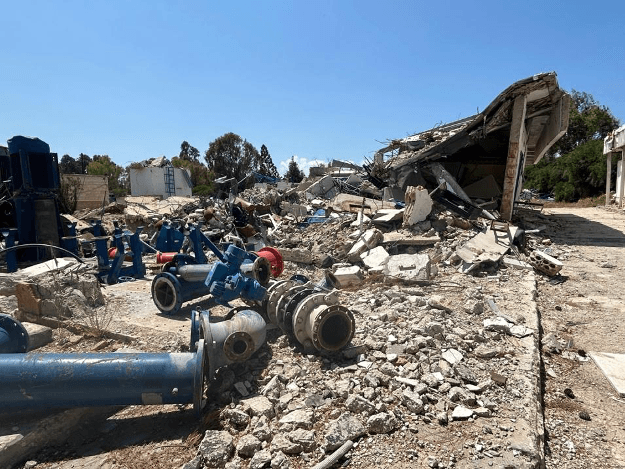
First, the publicly operated water supply system has been severely disrupted. The damage and destruction of water pumping stations were particularly impactful given that the flow of water through distribution networks across large geographic areas depends on their functioning. For example, when the main water pumping station in Tyre was severely damaged by an airstrike by Israeli armed forces in November 2024, water access to 72,000 people was disrupted.3 Frequently, running water remained unavailable for months after water infrastructure was initially damaged or destroyed. Limited financial resources and continued concerns about security were highlighted by interviewees as the main barriers to repairing damaged infrastructure.
Figure 1 – Tyre water pumping station following its destruction in an airstrike by Israeli armed forces in November 2024
Second, in locations where running water supplies were interrupted, communities became heavily dependent on private water sources or purchasing trucked-in water. According to the World Bank, trucked-in water costs households ten times more than water obtained from public water supply authorities.4 Vulnerable civilians in Lebanon already faced challenges accessing sufficient clean water at an affordable price amidst inflation and Lebanon’s socio-economic crisis since 2019. However, this situation was seriously exacerbated among affected communities, especially given that 166,000 individuals in Lebanon were estimated to have lost their jobs due to the conflict escalation as of late October 2024.5
Third, the disruption of water supplies heightened challenges for farmers requiring water for irrigating crops. More than 82 percent of farmers who were interviewed stated that, since October 2023, they had experienced difficulties accessing sufficient water to irrigate crops or provide drinking water for livestock. Although some referred to low rainfall as a contributing factor, these farmers stressed that disruptions to running water supplies had worsened the difficulties.
Fourth, the damage and destruction add significant financial burdens to the Lebanese state, already under pressure since the 2019 socio-economic crisis. This is not only due to the need for repairing damaged and destroyed infrastructure but also due to the loss of revenue by water authorities following the interruption of water services and the creation of “non-revenue water.” This denotes water that is lost or unaccounted for before it reaches the end consumer, and that consumers can therefore not be charged for.6 Overall, the conflict in Lebanon is estimated to have created losses of US$171 million across the water, wastewater and irrigation sectors.7
If appropriate action is not taken, further reverberating effects are also foreseeable. These include the risk of affected populations resorting to unsafe or contaminated water sources, the potential emergence of waterborne diseases and long-term forced displacement due to a lack of access to essential amenities such as water. As of July 2025, it was reported that only 28,000 people were living in southern Lebanese communities within five kilometres of the Israeli border compared with 92,000 before October 2023.8
Farmers and food production
As already highlighted, farmers and food production depend on adequate water supplies. However, the wide variety of reverberating effects from the use of explosive weapons on farmers and food distribution in Lebanon extended beyond those restricting water access.
Heavily agricultural areas of Lebanon have been disproportionately affected by explosive weapons. As of mid-January 2026, more than 10,000 air or drone strikes and over 6,000 instances of shelling, artillery, or missile fire have been reported in Lebanon since October 2023, over 98 percent of which were conducted by Israel. Around 85 percent of the air and drone strikes and 99 percent of the shelling, artillery and missile fire occurred in the southern governorates of Nabatieh and South.9 Pre-conflict escalation, Nabatieh was important for olive and fruit production and the South governorate hosted 94 percent of the country’s banana plantations and over 60 percent of citrus and avocado trees.10 The use of explosive weapons in these areas has had devastating impacts on farming communities.
Around 93 percent of interviewed farmers stated they had felt unsafe accessing land for planting or harvesting crops or grazing livestock since October 2023. For many farmers, feelings of being unsafe derived from perceptions of indiscriminate and unpredictable bombing. For example, one farmer stated that they left the area where they farmed because it was “too dangerous … due to random and chaotic airstrikes.” Other farmers described airstrikes as “sudden” and said that they “never knew when and where the hit will be.” Farmers also reported difficulties in finding agricultural labourers due to a collective loss of feelings of security.
The concerns about the unpredictable use of explosive weapons directly contributed to reduced food production by farmers. Around 90 percent of the interviewed farmers said that the overall amount of food they produced had reduced since October 2023. Several farmers in Khiam, Bodai and Saydeh, Baalbek and Aitaroun stated that their food production had reduced by 100 percent, depriving them of their income source. Additionally, farmers raised concerns about the presence of explosive remnants of war contaminating their agricultural land and rendering the land unsuitable for cultivation in the future.
Combined, the intense use of explosive weapons in heavily agricultural areas of Lebanon has contributed to creating a negative cycle of long-term reverberating effects which mutually reinforce one another. For example, the loss of collective senses of security led to difficulties obtaining agricultural labour. This leads to a reduction in the crops planted and harvested which reduces food production and income sources. In turn, this prevents farmers from making financial investments to restore and rehabilitate their farming activities. The outcome is a negative situation which is difficult for farmers to break out of without some form of external support.
Food distribution
Explosive weapons use has also had long-term negative impacts on food distribution and access. In October 2024, an airstrike by Israeli armed forces struck a historic souq in Nabatieh city, causing large-scale destruction to market stalls which previously sold food and other essential amenities.11 Approximately six months later, the market had reportedly still not returned to full functionality. Some market stalls had reportedly closed permanently whilst others moved to other locations, at financial costs for the traders.
Incidents such as the bombing of Nabatieh’s souq contributed to people feeling unsafe about travelling to markets and, in some cases, limiting journeys to these locations. Approximately two-thirds of those interviewed stated that they had felt unsafe using roads or transport routes to markets at some point since October 2023. They highlighted concerns about airstrikes on roads and a general atmosphere of fear. Five interviewees referred specifically to the bombing of the Nabatieh souq, showing an awareness among communities of explosive weapons directly affecting civilian areas vital for food distribution and indicating the impact of this on perceptions of safety at food markets.
Conclusions
The intensity of explosive weapons use in Lebanon has reduced following the ceasefire agreement between Israel and Hezbollah in November 2024. Yet, it has not ended. Since the 26 January 2025 ceasefire extension, over 1,100 Israeli-launched air or drone strikes, and over 500 Israeli-launched shelling, artillery or missile strikes, have been reported in Lebanon.12 Moreover, civilians in Lebanon – including those distant in time and space from where the weapons first struck – continue to live through the devasting effects of explosive weapons. Many of these were foreseeable. These same effects can be expected to arise in other conflict contexts if explosive weapons are employed with such intensity in proximity to civilians and civilian objects as has occurred in Lebanon.
As such, the findings highlighted here underscore once again the seriousness with which parties to conflict must take action to strengthen the protection of civilians from the foreseeable harms arising from the use of explosive weapons in populated areas.